
Charcot-Marie-Tooth CMT

Posted on March 31, 2026
CMT is an insidious health condition that gradually affects the peripheral limbs: hands and feet. As a result: balance and mobility are diminished.
A Public Example
Famous, Alan Jackson, the country western singer recently revealed his premature retirement due to an inability to perform on stage. Ankles are unable to support body weight. Holding items is a challenge as gravities' added pressure on the ankles exacerbates this.
Nature of the Disease
CMT is inherited. It is progressive and the symptoms slowly develop. It is one of the most commonly inherited nerve disorders.
Lack of Awareness
Most primary care givers never heard of the disease. There are different types of CMT and I have CMT1A. This affects the nerve's myelin: the protective sheath covering of the peripheral nerves.
Living with CMT
There is no cure so we must learn to cope. It is not life threatening. I wear AFOs (orthotics): ankle-foot braces when leaving home to avoid drop foot. I wobble with each step taken, and often trip and fall as toes touch the ground before the heel. The scars on my knees confirm this.
Early Signs and Misdiagnosis
The earliest sign that my ankles were problematic occurred when I ran the indoor track while attending high school. Sprinting would cause the achilles' tendon to pop. I attributed the slow pace to being overweight. "Why can't I run like everyone else?" Self esteem hit rock bottom. I was different, not like the other boys who were physical and competitive at sports. The doctors of that time period diagnosed flat feet the cause and I was forced to wear leather/metal arches in my shoes.
Discovery of CMT
I was in my late twenties when I heard the term CMT for the first time. Cousin Jacobo, my Cuban born and trained brilliant Internal Medicine/ Cardiologist stated that Mom and his mother-in-law physically showed signs of this disease.
A Personal Connection
The next time I heard this term, my six year old son who always lagged behind on the class line, DNA tested positive for CMT1A. His pediatrician never heard of the disease. This is an inherited neurological disorder. Muscles atrophy when not receiving electrical current and so exercise cannot improve affected muscles.
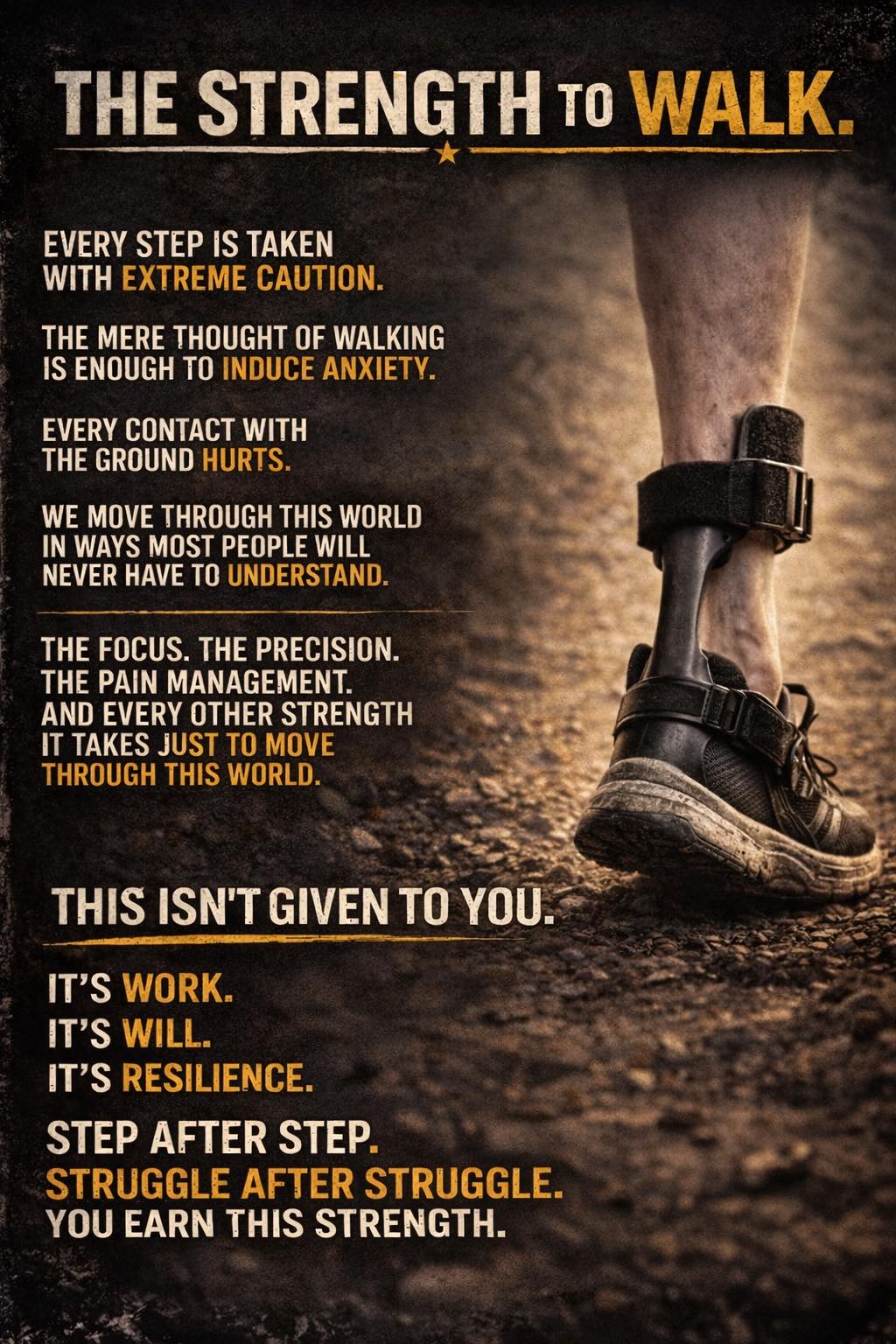
The Strength to Walk
Most people will never think about it. They’ll stand up, take a step, and move through the world without hesitation. For them, it’s automatic. For us, it’s war.
Every step is calculated. Where does my foot land? Is the ground stable? Will my ankle hold? Will this step cost me later? The mere thought of walking can trigger anxiety because we know what comes with it—pain, instability, and fatigue that builds with every step forward.
And still, we walk.
Not because it’s easy. Not because it feels good. But because we refuse to stop moving forward.
What most people will never see is what it takes—the focus, the precision, the constant adjustments, the silent fight happening in every single step. This isn’t normal movement. This is controlled chaos. This is strength under pressure. This is adaptation in real time.
You don’t just walk. You manage pain. You manage risk. You manage failure, step after step after step.
And that kind of strength isn’t given. It’s built. Earned through struggle. Forged through repetition. Proven every time you choose to keep going.
So if you’re still walking, understand what that means. You’re not weak. You’re not behind. You’re not broken.
You are doing something most people will never have to do.
And that makes you STRONGER THAN MOST PEOPLE WILL EVER NEED TO BE
Does anyone share similar challenges? Connect with me at ChasingtheMongoose.com
Contact Us
Send a Message
Contact me if you'd like to have a discussion. I'm here to connect and inspire, encouraging your message of transformation and understanding.